Mondai | House of AI, TU Delft | AI Initiative and the TU Delft | Transport & Mobility Institute present
AI & Mobility Day 2026!
Mobility, transport and logistics face a multitude of challenges: traffic congestion, quality-of-life issues, conflicting interests between users, operators and the public, a lack of space, and safety risks during large-scale events. These challenges are closely intertwined, making them particularly difficult to resolve.
Furthermore, much of the infrastructure in the Netherlands is approaching the end of its service life. This same infrastructure forms the connecting link for all mobility and transport, by road and water. However, expansion is becoming increasingly difficult and expensive, whilst space, staff and financial resources are also urgently needed for defence, healthcare, energy, education, nature conservation and housing. We will therefore have to use and maintain the existing infrastructure even smarter.
Whilst such complexity can overwhelm the human brain, it actually offers ideal applications for artificial intelligence (AI). AI can process vast amounts of data in real time, carry out accurate network analyses, simulate the effects of future scenarios and optimise interventions. Furthermore, AI enhances our understanding of human behaviour and of the transport system as a whole.
By organising mobility more intelligently, we can make better use of existing capacity – enabling us to move people and goods more efficiently and safely across the country. TU Delft’s expertise contributes to this with:
• Intelligent traffic management, e.g. using cameras, sensors and drones, advanced tools for traffic controllers, and data-driven mobility models that predict and optimise traffic flows;
• Innovative applications to optimise port logistics and encourage the modal shift from road to water;;
• Self-driving cars and autonomous inland waterway vessel;
• Smart charging and energy systems for electric vehicles;
• Digital twins of infrastructure for improved management and maintenance, including smart and predictive maintenance of bridges, tunnels and viaducts;
• Learning Communities such as AiMTT, which address the opportunities and challenges of AI in the fields of mobility, transport and logistics.
Programme
09.00 Walk-in and reception
09.30 Opening by Sascha Hoogendoorn-Lanser & Serge Hoogendoorn
Why is AI the talk of the day in transport, mobility and logistics, and what do we want to achieve today: no hype, but an honest picture of what is possible, what is not yet possible and what it asks of us.
09.40 Keynote: Responsible use of AI in the Traffic, Mobility and Logistics domain by Satish Ukkusuri (Purdue University)
An overview of the main AI methods and how they relate to questions in traffic, mobility and logistics: where the opportunities lie and where the risks and pitfalls are. This keynote lays the foundation and the shared vocabulary for the rest of the day.
10.20 Theme: What has to be settled before AI decides? by Neil Young Smith (TU Delft) & Diederick Blom (DB Consulting)
Autonomous inland vessels and AI-supported decisions are technically within reach, but adoption stalls somewhere else: practitioners don’t trust a result they can’t explain, and nobody wants the liability for a wrong one. Two projects examined different aspects of this challenge: on the one hand, they interviewed inland shipping experts and researchers about the real barriers to implementation; on the other hand, they considered who is accountable when an AI flags a vessel as a threat and entry is refused. Together, they map: what has to be settled before AI decides?
11.00 Coffee break
11.15 Keynote: Relevance of Traffic and Transportation Theory in the era of AI by Ludovic Leclercq (Université Gustave Eiffel)
Does traffic and transportation science remain relevant now that AI seems able to learn from data everywhere? An argument for why domain knowledge is indispensable precisely now, and how theory and AI can strengthen each other.
11.55 Theme: Active Inference for decentralised, resilient and cooperative traffic management by Olaf Vroom (NDW), Wouter Kouw (TU/e), Bert de Vries (TU/e), Dmitry Dagaev (TU/e), Xue Yao (TU Delft).
Active Inference approaches traffic management as a prediction process in which actors explicitly account for uncertainty and decide in a decentralised way, without losing sight of network-wide goals. Using concrete situations such as route choice, signal control and in-car advice, we explore what this framework means for road authorities and traffic control centres.
12.35 Lunch
13:30 Theme: Responsible use of explainable AI for anticipatory crowd management by Jeroen Steenbakkers (Argaleo), Hannah Louise Mulvihill (RUG), Isabel Franke (TU Delft), Tamara Dert (TU Delft), Ziteng Li (TU Delft)
AI can predict crowding and risk and support crowd managers in real time, but that only works if systems are explainable, privacy-proof and ethically responsible and the human stays in control. Using the AI-Compass pilots around events, demonstrations and busy days, we show how humans and AI reach better decisions together.
14:10 Theme: From estimation and prediction to evaluation: AI for traffic management by Henk Taale (RWS), Erik-Sander Smits (Arane), Yanan Xin (TU Delft)
What do traffic management measures really achieve? Rijkswaterstaat has to answer that question, not only for their own operations, but also for policy purposes. However, this is difficult: the mobility system is dynamic and circumstances change all the time. This challenge is approached from different angles:
• Henk Taale introduces the problem from evaluation practice. Why is determining effects difficult but essential?
• Erik-Sander Smits shows how AI is used to estimate and predict the traffic state – queue lengths, travel times and the development of congestion – and why that is not yet enough to evaluate traffic management.
• Yanan Xin then shows how causal and counterfactual inference give more reliable effect estimates than purely predictive models, illustrated with the effect of traffic signalling on incidents.
14.50 Break
15.05 Theme: AI to the rescue? The maintenance and replacement challenge by Ministery of Infrastructure and Water Management, and TU Delft
The Netherlands faces an enormous challenge in maintaining and replacing bridges, quay walls, locks and roads, while money and people are scarce. An exploratory session on where AI could help, from inspection with image recognition to prioritising investments to planning works to keep regions as accessible as possible: meant to spark curiosity, not to give ready-made answers.
15.45 Keynote:The future of AI and what it means for Transportation, Logistics and Infrastructure by Deborah Nas (TU Delft)
Which AI developments are coming our way in the years ahead, and what do they mean for transport, logistics and infrastructure, and for the professional’s daily work? A thought-provoking look ahead.
16.25 AI & Mobility November 4th Hackathon Winner and Runner-up pitches
16.55 Close
The common thread of the day, a look back at the propositions, and the question to the audience: what will we do differently tomorrow?
17.05 Drinks
From opportunity to impact
The potential of AI is enormous, but turning that potential into practical solutions requires close collaboration between researchers, governments and industry.
AI & Mobility Day 2026 is organised in collaboration with
Contact us


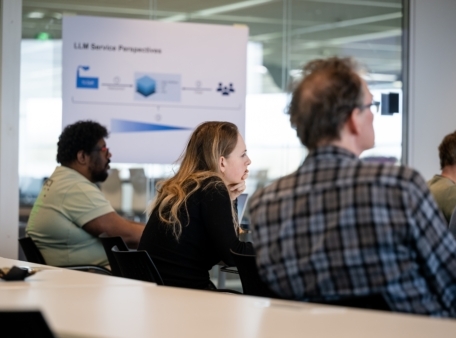
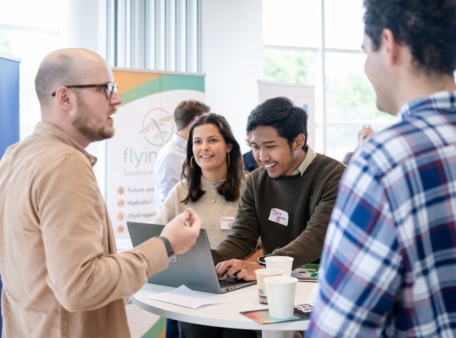
AI & Mobility Day 2025: Shaping the future of AI in Mobility
In 2025 we organised the first AI & Mobility Day, with great success. Experts from academia, the business world and the public sector came together to discuss the opportunities and challenges of AI in the mobility sector.
“Expectations for AI in mobility are immense—but will it be the game-changer we hope for, or just another overpromised technology struggling with the complexities of sustainable, resilient, and inclusive transport?”
– Serge Hoogendoorn, Distinguished Professor Smart Urban Mobility