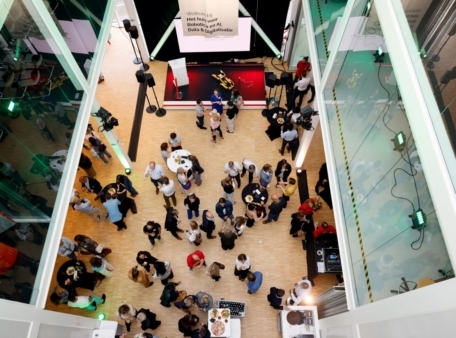
Are you a PhD or postdoc researcher at TU Delft working on AI-related topics? You are cordially invited!
Hosted on Wednesday May 27th (13:00 – 17:30) by Mondai | House of AI at YES!Delft (=updated location), this year’s event is going to shake things up and focus on a less-talked-about side of science – embracing scientific failures! The event includes poster pitches, an interactive panel discussion on the importance of negative results, errors, and failures in science, keynotes from final year PhDs, and the ever-important borrel. It’s an excellent opportunity to present your research (particularly what did not go to plan) and network with fellow AI-focused scholars across campus.
Programme 13:00 – 17:30
- Keynotes & talks from final year PhDs working in/with AI at TU Delft
- Panel discussion on embracing scientific failure
- Poster market: You are invited to contribute to this event with your own poster and/or abstract! See poster requirements below. Final deadline for participating with hand in: May 21st. Deadline for participating without poster and/or abstract: May 26th
The afternoon session will end in a casual manner with drinks, refreshments and an opportunity for networking. More details to be announced so keep an eye on this page for more updates on speakers and panellists!
Posters and/or ‘failure’ abstract
Researchers at all stages of their PhD and working in all different areas of AI are welcome:
- Machine learning and foundational AI techniques
- Human-centered AI systems
- Application of AI
- Fairness, bias, legal, and ethical considerations of AI
- Education and AI
- Design with AI
- Reflexive and critical research on AI
- And more…
Prizes for best poster and ‘failure abstracts’: for each a 3-month X subscription!
Requirements
You can choose to participate in this symposium with or without a poster and/or failure abstract. Deadline for posters and abstracts is May 21st.
You can submit either A) a poster with a short description of failure or B) a ‘failure abstract’, aka a short description of the research you wanted to do, but it didn’t quite work out.
- A) If you’re bringing a printed poster, we request a short description of the efforts that went awry before the successful work. What went wrong in the project before it succeeded? It can be a misstep, a small mistake, or a significant error—it can be any way to show that the research is rarely a smooth process.
- B) Alternatively, you can submit a short description explaining the intended goal and how it did not go to plan. Here, you don’t have to have succeeded; it can be an idea that you eventually abandoned!
- For A) Poster A1 or A0 size
- Printing is available via the AI Initiative for new posters in A0 format. Send in as PDF, JPEG, or PNG (portrait mode, 300 DPI).
- For A) and B), we expect abstract submissions of up to 300 words for both types. Send in as PDF or DOC(X).
- Submissions can be made via the registration form available on this page
- For A) Poster A1 or A0 size
Register & submit your poster and/or ‘failure abstract’ by 21st of May.
Any questions? Please contact the AI PhD Committee at AI-PhD-Committee@tudelft.nl
Speakers and Panel
How can we think about and practically approach our failures in science? And how can we make them visible through, for instance, documentation?
This panel explores what scientific failure really means across different disciplines, from rejected papers and failed grant applications, to broader personal and professional setbacks. Speakers reflect on how failure is defined within their fields, share their own experiences at both an individual and disciplinary level, and discuss how these moments have shaped their work. By examining not just the challenges but also the lessons learned, the panel aims to highlight how failure can be an essential and productive part of the scientific process.
During this panel discussion, Elvire Landstra (Tilburg University), Agostino Nickl (A+BE), Nazli Cila (IDE), and Megha Khosla (EEMCS) will shed light on different definitions of ‘scientific failure’ and how to deal with them.
Panel: Embracing scientific failure
How can we think about and practically approach our failures in science? And how can we make them visible through, for instance, documentation?
This panel explores what scientific failure really means across different disciplines, from rejected papers and failed grant applications, to broader personal and professional setbacks. Speakers reflect on how failure is defined within their fields, share their own experiences at both an individual and disciplinary level, and discuss how these moments have shaped their work. By examining not just the challenges but also the lessons learned, the panel aims to highlight how failure can be an essential and productive part of the scientific process.
During this panel discussion, Elvire Landstra (Tilburg University), Agostino Nickl (A+BE), Nazli Cila (IDE), and Megha Khosla (EEMCS) will shed light on different definitions of ‘scientific failure’ and how to deal with them.
Kom in Contact
We horen graag van je! Bij Mondai | House of AI helpen we je graag jouw kennis en die van jouw bedrijf of organisatie op het vlak van AI te ontwikkelen.