Industry & Science Workshop: Energy-Efficient AI Systems for a Sustainable tomorrow
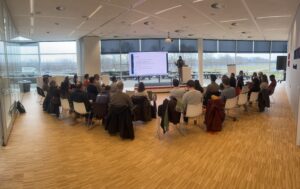
We were very pleased with the energy and interaction of the participants at the Industry & Science workshop on Energy Efficient AI Systems for a Sustainable tomorrow, on the 5th of February 2026.
Below you find the results of this workshop.
Next steps: Based on the information we have at this moment, we will focus on a project funding opportunity (including NWO Perspectief) in the second half of 2026. This is a bigger funding opportunity, allowing us to integrate different innovation challenges into one project. Please let us know if you would like to be involved in this initiative or have other ideas how to create a large-scale program related to the topic of green AI.
First, Rajendra Bishnoi, Przemek Pawelczak and Aaron Ding, TU Delft Scientific lead on the topic of Energy Efficient AI Systems, presented the challenges in AI regarding energy-efficiency from the perspective of the three main system elements: Hardware; Software & Algorithms, Development & Deployment tools.
During the interactive part of the workshop, all industrial and academic participants of the workshop identified key innovation challenges that need to be addressed in the endeavor to make AI systems more energy efficient:
- How can we make AI users (organizations and consumers) aware of energy costs and how can we encourage organizations to make well-considered decisions without this becoming too much of an (economic) burden?
- To make informed decisions regarding energy-efficient AI, (standardized) methodology for energy measurement and privacy-friendly data sharing on emissions are needed. This will also allow for reporting and benchmarking on energy efficiency. This is not only a technological issue but also a regulatory and policy issue, for example, regarding the sharing of energy consumption data by suppliers.
- Memory efficiency (data movement) takes up a bigger part of the energy needed for AI. Traditional hardware (CPU’s & GPU) cannot solve this, so new technology is needed like in-memory computing and advanced CMOS to squeeze as much data as possible on the chip, but also smart ways to move data in datacenters energy efficiently.
- Efficient hardware for on-device learning (on chip or at the edge) is needed. Especially for applications at the edge where real-time is an issue (environment and domain changes) and requires on-device learning. This also includes support for on-chip fine-tuning to continuously update models locally.
Based on the information we have at this moment, we will focus on a project funding opportunity (including NWO Perspectief) in the second half of 2026. This is a bigger funding opportunity, allowing us to integrate different innovation challenges into one project. Please let us know if you would like to be involved in this initiative or have other ideas how to create a large-scale program related to the topic of green AI.